Car hire in Djibouti: 4×4, saloon or driver?
Hiring a car in Djibouti is mainly justified for getting around town and on the main tarmac axes: a saloon is enough there. For Lake Assal, the Goubbet, Lake Abbe or the Grand Bara, a 4×4 is needed, and most often a driver who knows the track. A 4×4 with a driver costs about 44,000 Djiboutian francs per day per vehicle, which becomes worthwhile from four people.
Can you hire a car in Djibouti?
Yes, and it is even the most flexible way to visit the country if you accept driving yourself. Several local agencies hire saloons and 4×4s, including Ets Marill and Pyramid Car Rental. The counters at Ambouli international airport also offer vehicles on arrival.
Two reservations, however. The first concerns mileage and insurance: on track, most contracts exclude damage to the vehicle, to the tyres and to the underbody. The second concerns assistance: outside the tarmac axes, there is no organised breakdown service.
Hiring a car in Djibouti is therefore not difficult. Hiring the right car for the right itinerary is harder: that is where most travellers get it wrong.
What are the car hire options in Djibouti?
| Formula | Vehicle | Indicative cost | Where the track is passable | For whom |
|---|---|---|---|---|
| Free hire | Saloon | Rate not published by the agencies: ask for a quotation | Tarmac roads: Djibouti City, Arta, Tadjourah, Lake Assal as far as the salt pans in dry weather | Urban stays, short journeys, independent arrival |
| Free hire | 4×4 | Rate not published by the agencies: ask for a quotation | Dry tracks of the Goubbet, Lake Assal and Dittilou | Experienced travellers, groups of 4 |
| Hire with driver | Saloon | On quotation, generally close to the free rate plus a premium | Same axes as a saloon, with a local driver | Travellers who want to avoid local driving |
| Hire with driver | 4×4 | About 44,000 Fdj per vehicle per day | Almost all tracks in dry weather: Lake Abbe, Abourma, Grand Bara, Forêt du Day | Groups, families, inland sites |
| Organised excursion | 4×4 with guide | About 18,000 Fdj per person per day | Classic sites: Lake Assal, Goubbet, Ardoukoba | Solo travellers, couples, first stay |
| Taxi and transfers | Saloon with driver | From 600 Fdj per zone in town; about 1,500 Fdj from the airport (single value in the ANT grid) | Town only | No travel outside built-up areas |
A simple calculation marker. The day of 4×4 with a driver pays for itself from four people: 44,000 Djiboutian francs divided by four drops below the per-person rate of an organised excursion. Below three passengers, the organised excursion remains almost always cheaper.
Where is the track actually passable?
| Axis | Surface | Saloon | 4×4 |
|---|---|---|---|
| Djibouti City → Arta | Tarmac | Yes | Yes |
| Djibouti City → Lake Assal | Tarmac, final track to the salt pans | Yes in dry weather, with care | Yes |
| Djibouti City → Tadjourah (about 180 km) | Tarmac | Yes | Yes |
| Djibouti City → Obock (about 240 km) | Tarmac | Yes | Yes |
| Djibouti City → Goubbet al-Kharab | Tarmac then track | No | Yes |
| Djibouti City → Lake Abbe | Long track | No | Yes |
| Djibouti City → Abourma | Track and walking | No | Yes |
| Djibouti City → Forêt du Day and Dittilou | Tarmac then mountain track | No | Yes |
| Djibouti City → Khor Ambado (about 20 km) | Track | No | Yes |
The steep descent to certain beaches, such as Khor Ambado, is a textbook case: the track is short but abrupt, and a saloon leaves its underbody there. Lake Assal, for its part, is reached by tarmac road for almost the whole journey: only the last kilometres and the descent to the salt pans are on track.
Is it better to hire or to book an excursion?
| Criterion | Free hire | Hire with driver | Organised excursion |
|---|---|---|---|
| Price per person | Lowest from 4 | Comparable to the excursion from 4 | Highest solo |
| Knowledge of the tracks | Your responsibility | Good | Very good |
| Access permits | Your responsibility | Often handled | Handled |
| Breakdown or puncture | Your responsibility | Handled | Handled |
| Freedom of hours | Total | Good | Limited |
Three sites require accompaniment whatever the formula: Lake Abbe, Abourma and the Seven Brothers archipelago. Access there depends on local permits and on a navigation one does not attempt without knowledge of the terrain.
How do you hire: agencies, documents and formalities
Two local agencies are documented for vehicle hire: Ets Marill and Pyramid Car Rental. The capital’s hotels can also act as intermediaries.
Prepare four documents: a national or international driving licence, a passport, a bank card imprint and an accommodation address. Systematically ask, in writing, for:
- the amount of the excess in case of damage;
- whether tyres and the underbody are covered;
- whether mileage is unlimited;
- whether leaving the built-up area is allowed by the contract;
- a serviceable spare wheel and a jack, checked in front of you.
How do you drive in Djibouti?
You drive on the right. A French driving licence is accepted for a tourist stay — that is the case our sources document; other nationalities should check with the hire company, which asks for a national or international licence. Traffic in Djibouti City is dense and undisciplined; overtaking on the right and sudden stops are frequent.
A few useful rules:
- Fill up before every departure inland. Petrol stations thin out very quickly off the main axes.
- Take water and a spare wheel. A puncture on track is repaired by yourself or not at all.
- Avoid driving at night outside built-up areas. Vehicles without lights and stray animals are a real risk.
- Expect police checks on the national roads. Keep your passport and the vehicle papers to hand.
- Do not leave the marked track. Certain border areas are sensitive and access there is regulated.
What should you do in case of a breakdown or an accident?
Notify the hire agency immediately: it is a usual clause of the contract, and an improvised repair can void the cover. In tarmac areas, help comes from Djibouti City; on track, you have to rely on yourself or on the nearest camp.
In case of personal injury, alert the police and do not move the vehicle until a report has been drawn up. Have a written report completed, even a sketchy one, and photograph the scene from several angles.
The most useful reflex remains prevention: never set off alone on a long track, report your itinerary and your expected return time, and carry a water reserve greater than your estimate.
How do you get around without hiring a car?
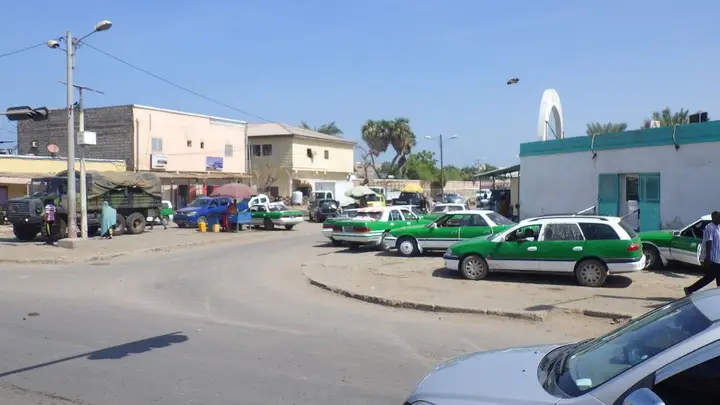
The taxi remains the simplest mode in town. Rides start at around 600 Djiboutian francs per zone, to be negotiated before getting in, since meters are not used. From Ambouli international airport, seven kilometres from the centre, the ANT publishes a single value — allow about 1,500 Djiboutian francs — and not a range: the 1,000 Fdj floor seen with certain guides does not come from the agency, and we do not attribute it to them.
For distant sites, the organised excursion usefully replaces hire: transport, guide and access permits are included, and you have no fuel, no puncture and no insurance to manage. The ferry of the Safar Salam company also provides the link to Tadjourah and Obock, which avoids 180 to 240 kilometres of road to reach the north coast.
Hiring a car is therefore really useful in only two cases: you are staying several days and multiplying urban journeys, or you want to compose your own itinerary outside the offered tours.
Hire, taxi or excursion: what should you choose?
- Staying in town and making a few nearby outings? The taxi is enough. From 600 Djiboutian francs per zone, it costs less than three days of hire.
- Two of you aiming for the classic sites? The organised excursion is the best deal: transport, guide and logistics included.
- Four or more of you? The 4×4 with a driver becomes the best value for money, and it opens the tracks to Lake Abbe and Abourma.
- You want to improvise and stay independent? Free hire holds up in town and on the tarmac axes, provided you accept the insurance risk on track.
To settle the journeys once the vehicle is chosen, see the ferry to Tadjourah and Obock: on the north coast, the boat avoids 180 to 240 kilometres of road. For the must-see sites and their real visiting time, see what to see in Djibouti.
Frequently asked questions
Can you hire a car in Djibouti without a driver?
Yes, several local agencies offer free hire, notably Ets Marill and Pyramid Car Rental. Plan for a national or international driving licence, an identity document and a bank card imprint. Above all, check what the insurance covers: on track, most contracts exclude damage to the vehicle, and assistance remains limited off the tarmac axes.
Do you need a 4×4 to visit Djibouti?
It depends entirely on the axis. A saloon gets through without difficulty on the Lake Assal road as far as the salt pans in dry weather, and towards Arta and Tadjourah. Lake Abbe, Abourma, the Dittilou cirque, the Grand Bara and the Forêt du Day, on the other hand, require a 4×4: long track, corrugated iron, sand or basalt crossings. Hiring a saloon for those sites is a frequent mistake.
How much does hiring a 4×4 with a driver cost in Djibouti?
Allow about 44,000 Djiboutian francs for a full day per vehicle, driver and fuel generally included. The rate is justified from four passengers: divided per person, it becomes lower than an organised excursion. For a standard day excursion, transport and guide included, allow rather around 18,000 Djiboutian francs per person.
How much does a taxi cost in Djibouti City?
Rides in town start at around 600 Djiboutian francs per zone, with a fare to be negotiated before getting in, since meters are not used. For the transfer from Ambouli international airport, seven kilometres from the centre, the National Tourism Agency publishes a single value, about 1,500 Djiboutian francs. Plan for cash: not every driver accepts bank cards.
What are the driving rules in Djibouti?
You drive on the right. A French driving licence is accepted for a tourist stay — that is the case our sources document; other nationalities check with the hire company, which asks for a national or international licence. Traffic is dense and undisciplined in Djibouti City, with many police checks. Fuel is easy to find on main axes but rarely on the tracks: fill up before every departure inland. Avoid driving at night outside built-up areas.
Sources
Practical
Read next
4×4 with a driver in Djibouti: prices and itineraries
Accessibility in Djibouti: what a demanding trip implies
Boat hire in Djibouti: trips out to sea
Budget in Djibouti: what does a trip cost on the spot?
Buses and taxis in Djibouti: fares by zone and route
Connectivity and SIM cards in Djibouti: internet and mobile
Djibouti airport transfer: taxi, fares and arrival
Djibouti–Addis Ababa train: line, tickets and station