Balho: rock art and the northern border post
Balho is a small border locality in the Tadjourah region, in northern Djibouti, on national road 11, a few kilometres from Ethiopia. It is known for its rock art, which archaeologists tie to the period of the first cattle herders: the oldest horizon of rock art in the Horn of Africa. Since 2020 it has held the third official crossing point between the two countries.
Where is Balho?
Balho is a small border locality in northern Djibouti. It belongs to the Tadjourah region, on national road 11, about thirty kilometres west of Dorra and a few kilometres from the Ethiopian border. The gazetteer consulted places it at 12.058 north latitude and 42.196 east longitude.
| Reference | Published data | Source |
|---|---|---|
| Administrative region | Tadjourah | Wikipedia; European Commission |
| Position | On national road 11 | Wikipedia |
| Distance from Dorra | about 32 km west | Wikipedia |
| Distance from the border | about 6 km from the Ethiopian border | Wikipedia |
| Crossing point | Third official entry point between Djibouti and Ethiopia | European Commission |
| Administrative status | Locality of the Tadjourah region | Wikipedia |
Balho is sometimes attached to the Dikhil region: that is an error. Every source consulted — encyclopaedic, administrative and European — places it in Tadjourah, at the northern end of the border between the two countries. Lake Abbe, another border site, belongs on the contrary to the Dikhil region and is reached by another route.
What can you see at Balho?
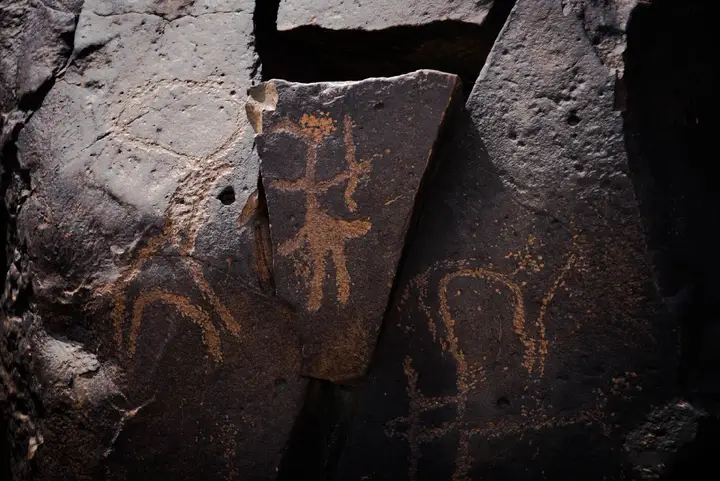
Balho is first of all a rock art site. The TRACES laboratory, which studies the rock art of the Horn of Africa, explicitly classes Balho alongside Abourma and Dorra among the sites of the country’s north that “perfectly illustrate the period of the first herders”. Now the same team places the beginning of that art in the era of the first cattle herders, nearly five thousand years ago: Balho therefore belongs to the oldest horizon of rock art in the region, that of the first pastoral societies.
One detail of cultural history deserves mention: in 1974, in the former French Territory of the Afars and the Issas, the Balho paintings served as a motif for stamps. The site was therefore already identified and judged representative half a century ago.
Beyond the rock art, the sources consulted describe no other equipped attraction. Balho is a village, not a tourist site: there is no museum, no waymarked path, no documented ticket.
How old are the Balho rock paintings?
This is where precision is needed, because the sources do not agree.
| Attribution | Advanced dating | Source |
|---|---|---|
| Balho paintings | about 10,000 years | Wikipedia (Balho) |
| First cattle herders | nearly five thousand years ago | TRACES laboratory (CNRS / Université Toulouse-Jean Jaurès) |
The two markers differ by a factor of two. We publish both, with their origin, rather than choosing one: it is for the reader to know that the dating of the site is not settled.
One piece of context helps read the whole. The same team places the rock art of the Horn of Africa from the era of the first cattle herders, nearly five thousand years ago, to the middle of the first millennium of our era: it is therefore not an art of a single moment, but a practice spread over several millennia. On the Dakka massif, in the south-west of the country, the same researchers note that the dromedary — the domestic animal best adapted to drought — becomes the engravers’ favourite motif, while humped cattle point to an earlier period: the sequence reflects a progressive aridification. At Balho, further north, the rock art belongs to the earlier horizon, that of the first herders, as at the Abourma rock engravings.
Why does Balho matter in recent history?
The village has a second history, much more recent and much harsher.
1991. Three Afar opposition groups met at Balho to form the Front for the Restoration of Unity and Democracy (FRUD), during the Djiboutian civil war. 1993. The army retook Balho, Dorra and Randa, and pushed the movement north. The village therefore lies on a fracture line of national history.
2019. On 6 November, the President of the Republic inaugurated the Tadjourah-Balho road, an entirely paved axis, at a ceremony held in Dorra. The presidency presents that corridor as a growth lever for the whole north of the country, complementing the southern corridors. The port of Tadjourah, opened in 2017, is to carry potash and goods from north-eastern Ethiopia.
2020. On 20 September, an official crossing point opened at Balho, in the presence of the authorities of both countries. It is the third entry point between Djibouti and Ethiopia, after Galafi to the west and Dewele to the south-west. The European Union, which supported the operation, also presents it as a tool in the fight against trafficking and irregular migration: Balho lies on the eastern migration route leading from the Horn of Africa towards the Gulf countries, with Djibouti as the main transit country.
Two months earlier, in July 2020, the corridor had been declared fully operational: the first bulk carrier to dock at the port of Tadjourah unloaded fifty thousand tonnes of coal bound for Ethiopia, carried by road to Balho by more than one thousand two hundred and fifty trucks. The rock art village is therefore also a heavy transit point.
How do you get to Balho?
| Access | What is documented | Source |
|---|---|---|
| National road 11 | Tadjourah-Balho axis entirely paved, inaugurated in November 2019 | Presidency of the Republic; DPFZA |
| Border | Official crossing point opened on 20 September 2020 | European Commission |
| From the coast | Tadjourah, by the RN11, passing through Dorra | Wikipedia |
| Commercial offer | No excursion dedicated to Balho in the Dalmar catalogue | Catalogue of the dossier |
It has to be said plainly: no offer in the booking catalogue covers Balho. The traveller who wants to see the rock art must organise the trip themselves, with a vehicle and a driver. This is a roadside excursion, not a tourist product: no visitor facility is documented there.
What should you know before setting off?
- This is a border zone. Balho is a crossing post, with the controls that implies. Always carry an identity document or passport, even if you do not intend to cross the border.
- Check your formalities before considering a crossing: visas and entry conditions up to date on both sides, on the official visa portal.
- Do not photograph the control installations or the infrastructure: photographing public and military buildings is forbidden in Djibouti, and a border post is one of them.
- Plan everything from Tadjourah or Djibouti City. No ticket, no appointed guide and no accommodation are documented there by the sources consulted.
- Carry water and fuel accordingly. The axis is desert, and the road was designed for freight, not for stops.
- Respect the paintings. Do not touch the walls and do not wet them: the surface is fragile, and the site is not permanently watched.
Preparing your trip
Balho belongs to an itinerary of the north of the country, and combines badly with a day trip from the capital: it is a stage, not a place to stay. Two neighbours in the region deserve to be associated:
- Tadjourah, the white city, departure point of the RN11 and maritime gateway to the north;
- the Forêt du Day and the Goda mountains, for the green face of the same region.
Given the distance and the border status of the sector, the most realistic formula remains to group Balho with Dorra and the interior of Tadjourah in a single trip, rather than making it an isolated destination.
Frequently asked questions
Where is Balho?
In the Tadjourah region, northern Djibouti, on national road 11. The published coordinates are 12.058 north and 42.196 east. The locality lies about thirty kilometres west of Dorra and only a few kilometres from the Ethiopian border. It is sometimes attached to the Dikhil region: that is an error, every administrative source consulted places it in Tadjourah.
What can you see at Balho?
Its rock art. The TRACES laboratory classes Balho, alongside Abourma and Dorra, among the sites of the country's north that illustrate the period of the first cattle herders, that is, the oldest horizon of regional rock art. The sources consulted document no equipped visit, no entrance ticket and no opening hours: the visit is prepared with local accompaniment and a vehicle.
How old are the Balho rock paintings?
The published sources do not agree. Wikipedia attributes to the Balho paintings about 10,000 years. The TRACES laboratory, which studies the rock art of the Horn of Africa, ties Balho to the period of the first cattle herders, which it places nearly five thousand years ago. The two markers differ by a factor of two: keep the order of magnitude, not a date.
Can you cross the Ethiopian border at Balho?
Yes, since 20 September 2020. A crossing point opened there on that date, making it the third official entry point between the two countries, after the Galafi post to the west and Dewele to the south-west. Present yourself with a valid passport and up-to-date formalities on both sides; the post was also set up to combat trafficking and irregular migration.
How do you get to Balho?
By national road 11, the Tadjourah-Balho axis inaugurated on 6 November 2019 and entirely paved. It is the third road corridor linking Djibouti to Ethiopia: it carries potash and goods from north-eastern Ethiopia towards the port of Tadjourah. The booking catalogue offers no excursion dedicated to Balho: plan for a vehicle and a driver.
Sources
- Wikipedia — Balho (region, road, rock art, recent history)
- European Commission — Emergency Trust Fund for Africa: opening of the Balho crossing point
- Djibouti Ports and Free Zones Authority (DPFZA) — commissioning of the Tadjourah-Balho corridor
- Presidency of the Republic of Djibouti — inauguration of the Tadjourah-Balho road, 6 November 2019
- TRACES laboratory (UMR 5608, CNRS / Université Toulouse-Jean Jaurès) — the rock art of Djibouti
- Wikipedia — Djibouti–Ethiopia border (official crossing points)
- Ethiopian News Agency — inauguration of the Tadjourah-Balho road (port of Tadjourah, 2017)
- GOV.UK — Foreign Office travel advice (ban on photographing certain infrastructure)
- Fallingrain gazetteer — Balho, Tadjourah region (position and name variants)
- ANT — Balho and prehistory (official factsheet, 92 words)
Location
Lat. 12.05790Lng. 42.19550
Destinations
Read next
Abourma: the rock engravings of the Makarrassou massif
Ali-Sabieh: the south-east region, sites and camps
Allols depression: salt, hot springs and caravans
Ardoukoba: the most recent volcano in Djibouti
Arta: the cool of the interior and whale sharks
Assamo: the protected area of the beira antelope
Bankoualé: the oasis at the foot of the Goda massif
Daasbiyo cave: rock paintings and burial mounds