
Where to stay in Djibouti: districts, hotels and camps
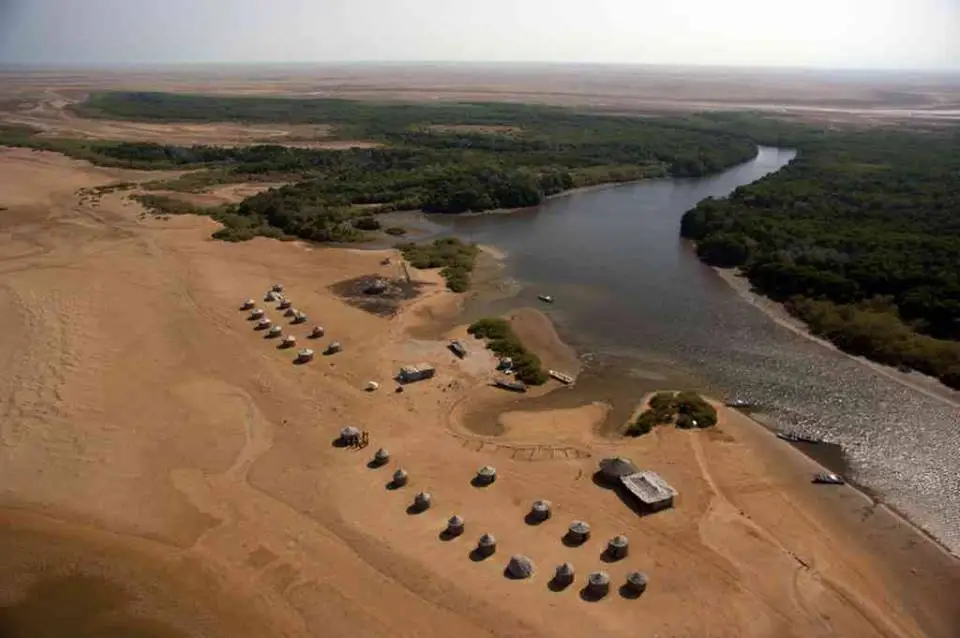
Most travellers to Djibouti City sleep on the Plateau du Serpent, the business and hotel district, or around Le Héron, which is more residential and close to the only truly swimmable city beach. Haramous suits early departures, seven kilometres from the airport. The old town remains the cheapest option. Outside the capital, Tadjourah and Obock offer hotels and camps right on the sea.
| Region | Djibouti City |
|---|---|
| Updated on | 16 September 2026 |
Where to stay in Djibouti?
The question is asked differently here than elsewhere. Djibouti City’s hotel stock is concentrated on a small area: most establishments sit on the Plateau du Serpent or immediately around it. Choosing a hotel here therefore means choosing a district first — and that choice sets your journeys, your background noise and the share of your budget that will go on taxis.
Which pages does this guide cover?
Twenty pages, grouped by use: six by geographical area, three by price band, nine for camps, plus the general file on camps and ecolodges.
By area
| Area | What you find there | Page |
|---|---|---|
| Djibouti City | The Plateau du Serpent, Le Héron, Haramous, the old town | Where to stay in Djibouti City |
| Tadjourah | The north coast, Les Sables Blancs, seaside hotels | Where to stay in Tadjourah |
| Arta | Inland, away from the coastal heat | Where to stay in Arta |
| Obock | The former capital and its coast, camps included | Where to stay in Obock |
| Dikhil and Lake Abbe | The south-west and the Gobaad bivouacs | Where to stay in Dikhil and at Lake Abbe |
| Ali-Sabieh | The south-east, on the railway axis | Where to stay in Ali-Sabieh |
By price band
| Band | Listing criterion | Page |
|---|---|---|
| High end | Establishments listed 4 and 5 star | Luxury hotels in Djibouti |
| Affordable | Establishments listed 2 and 3 star | Affordable hotels in Djibouti |
| Residences and apartments | Rentals with a kitchenette or several rooms | Residences and apartments |
The camps, one by one
| Camp | Region | Page |
|---|---|---|
| Dittilou | Tadjourah, Goda massif | Dittilou camp |
| Djalelo | Arta | Djalelo camp |
| Assamo | Ali-Sabieh | Assamo camp |
| Dhaydhan | Ali-Sabieh | Dhaydhan camp |
| La Maison des Randonneurs | Arta | La Maison des Randonneurs |
| Rayali chez Fato | Tadjourah | Rayali chez Fato camp |
| Ras-Bir Houguef | Obock | Ras-Bir Houguef camp |
| Village de la Mer Rouge | Obock | Village de la Mer Rouge |
| Seven Brothers | Obock | Seven Brothers camp |
And to understand what a Djiboutian camp actually is — comfort, electricity, water, meals, booking — the file camps and ecolodges lists them by region.
Three logics compete. Sleep in the centre, to walk in the evening and eat out. Sleep around Le Héron, for the sea air and the beach. Sleep towards Haramous, for proximity to the airport. The old town, around the market, answers a fourth logic: budget.
Outside the capital, the offer changes nature entirely. Tadjourah and Obock have seaside hotels and bungalows, and the country counts about ten ecotourism camps that are often worth the journey in themselves.
Which are the districts of Djibouti City?
The ranges below are indicative orders of magnitude, given to compare districts with each other — not rates. We do not have a reliable public price survey for Djibouti City’s hotels, and we would rather write that than display a firm price we cannot guarantee. The price you can hold us to is the one shown on Dalmar.
| District | Type of offer | For | Against | Indicative price order (Fdj / night) |
|---|---|---|---|---|
| Plateau du Serpent | Business hotels, apartments, residences | Everything on foot: restaurants, shops, services; lively in the evening | No beach, heavy traffic, the most expensive | High for the country |
| Le Héron | Upmarket hotels, villas, residences | Quiet, sea air, swimmable beach a few steps away, embassies | Fewer local shops, taxi needed for the centre | Medium to high |
| Haramous | Transit hotels, recent residences | Ten minutes from the airport, quiet area, close to Douda | Far from restaurants and the centre, a car is essential | Medium |
| Old town and central market | Small hotels, guesthouses | The cheapest, character, market and old town on foot | Basic comfort, noise, few internationally standard establishments | The lowest |
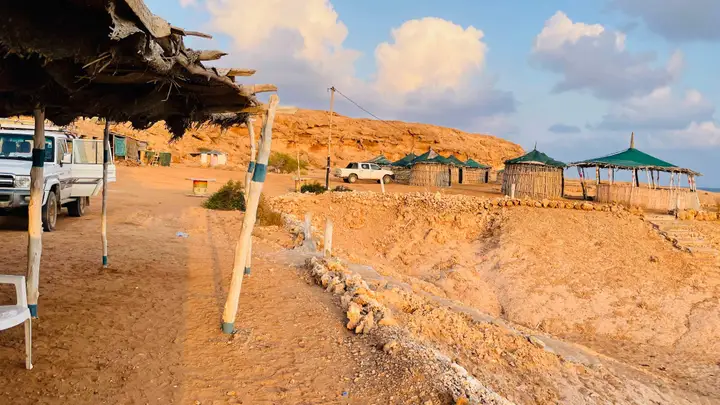
| Camps and north coast (outside Djibouti City) | Paillotes, bungalows, dormitories, toukouls | Seaside, nature, immersion | Simple comfort, sometimes with no running water or continuous electricity | Comparable to the old town |
The Plateau du Serpent
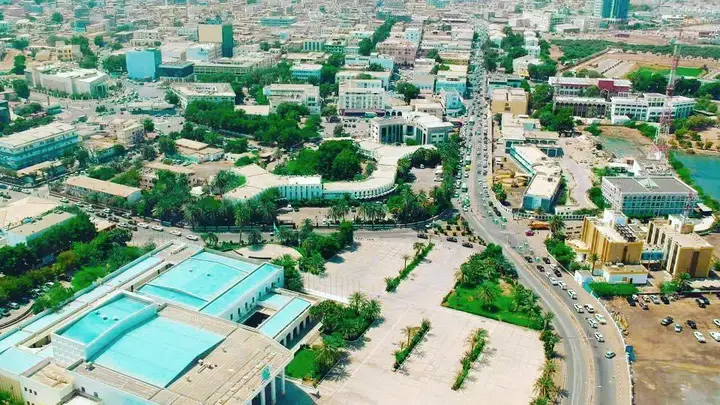
This is the modern heart of the capital: banks, ministries, agencies, restaurants and the majority of the hotels. Everything is done on foot, which is rare in a city where distances are measured in taxi rides.
Who for? Business travellers, those staying one or two nights who want everything within reach, and those who prefer to eat out without arranging transport. The offers available on Dalmar in that logic include several apartments and rooms in residences, some with a sea view.
The limits. No beach: the sea is a port. Traffic is heavy in office hours, and the district is the most expensive in the city.
Le Héron
Le Héron is the elegant residential district, the one with the embassies and the villas. Le Héron beach, right beside it, is the only city beach in the capital where swimming is genuinely advised: the water is clean and the sea breeze constant. Several well-regarded restaurants are immediately nearby.
Who for? Stays of several days mixing work and rest, families, and travellers who want to sleep in peace without giving up the sea.
The limits. Few local shops and frequent reliance on taxis to reach the Plateau du Serpent. The hotel offer is narrower, so book early in high season.
Haramous
Haramous occupies the south of the built-up area, about seven kilometres from Ambouli international airport, or some ten minutes by road. It is a residential and recent sector, which also contains the Haramous-Douda marine protected area, a sanctuary of mangroves, seagrass beds and reefs.
Who for? Late arrivals, early departures, long stopovers, and travellers who want to head straight on to Douda beach. Several offers on Dalmar explicitly claim proximity to the airport.
The limits. The district is outlying: without a vehicle, every dinner becomes a taxi negotiation. Evening life is elsewhere.
The old town and the central market
Around the central market and the Al-Hamoudi mosque, built in 1906, the old town keeps its houses with wooden balconies and an atmosphere the rest of the capital has lost. It is also where the cheapest accommodation is found.
Who for? Travellers on a tight budget, those who value atmosphere and walking, and photographers.
The limits. Comfort is often basic: uncertain air conditioning, no sound insulation, shared bathrooms. Let us also be honest that swimming is not advised on the Siesta city beach, because of cleanliness problems linked to nearby discharges. You go there for the atmosphere and the kitesurfing, not to swim.
Where to stay in Tadjourah and Obock?
The north coast justifies staying overnight rather than making the round trip in a day.
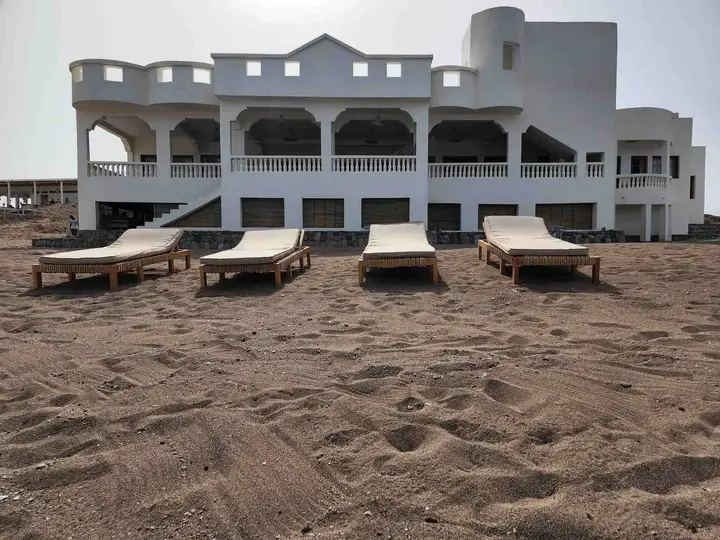
Tadjourah. The white city has several established hotels, including Le Golfe, Corto Maltese and Gadileh Resorts Hotel, as well as restaurants such as La Brise near Fiaa beach. Five kilometres away, the Les Sables Blancs site offers accommodation on the hotel side and the paillote side, below the black rock cliff. On Dalmar you will find the full-board camp and a boat trip there.
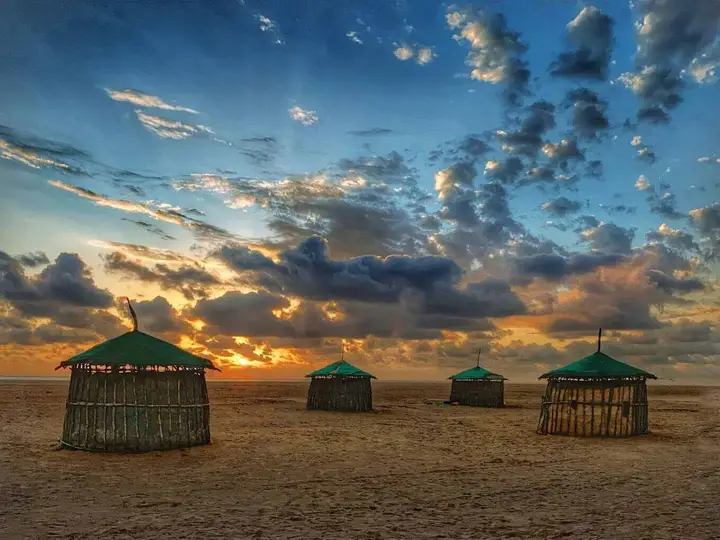
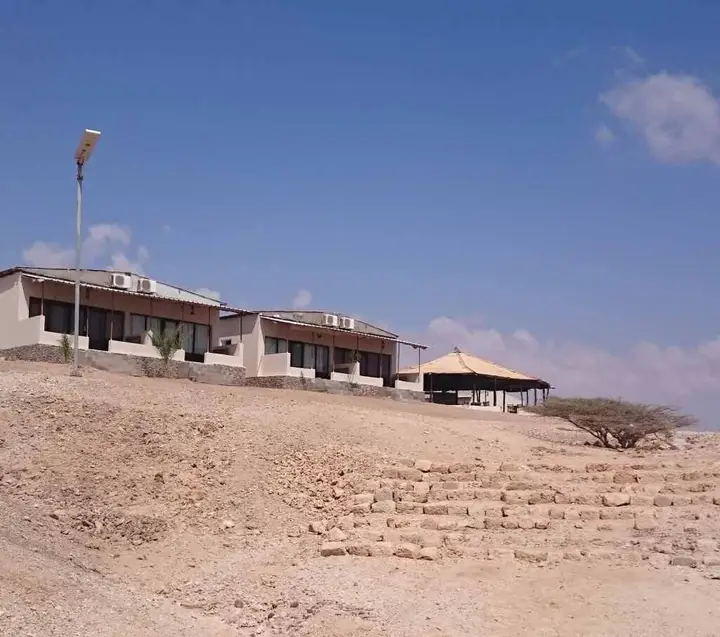
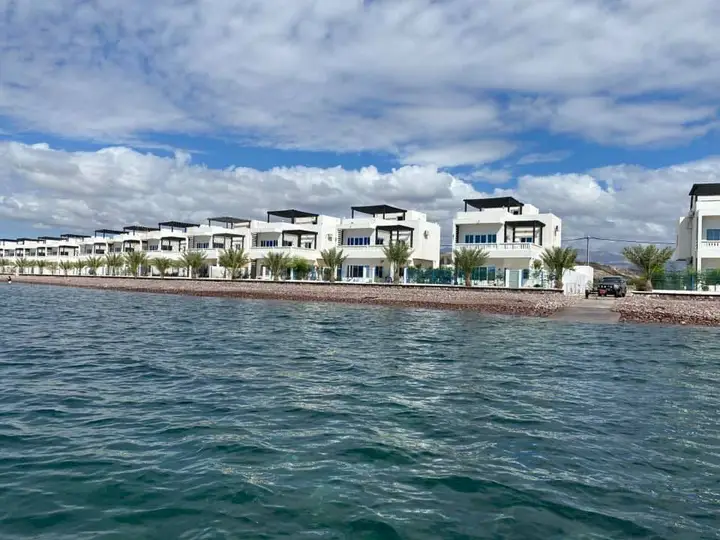
Obock. Village de la Mer Rouge, less than a kilometre from the town, lines up about fifteen rooms in bungalows: four luxury bungalows facing the sea, six bungalows on the hill and six simpler bungalows on the beach — the latter cooled by the wind, the catalogue not documenting air conditioning — with private bathrooms and shared toilets. The site has town water and a solar unit, and it is regularly visited by dolphins.
Sleeping in a camp: how does it work?
The country has nine listed ecotourism camps, often tied to protected areas. Comfort there is simple, but the experience is hard to match.
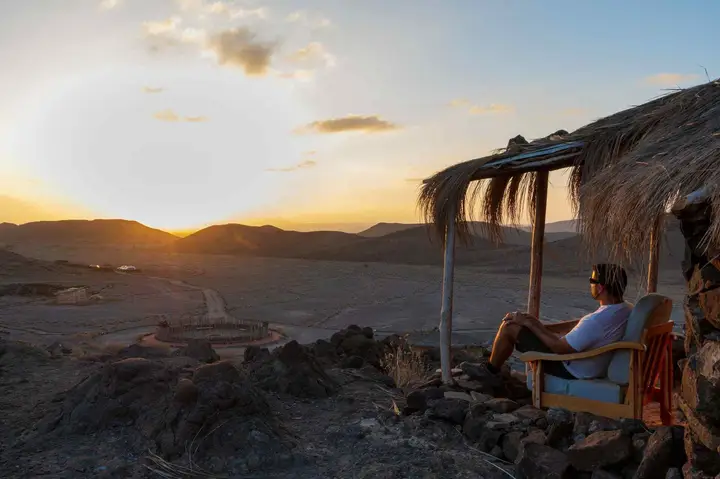
- Forêt du Day and the Dittilou cirque — a mountain camp, starting point for hikes, with green monkeys and baboons as breakfast neighbours.
- Djalélo — a non-profit ecotourism camp, eight rooms, three showers, about thirty people welcomed, in a valley listed as a protected area since 2011.
- Assamo — five rooms, three showers, twenty-eight people, in the heart of the Beira antelope’s habitat.
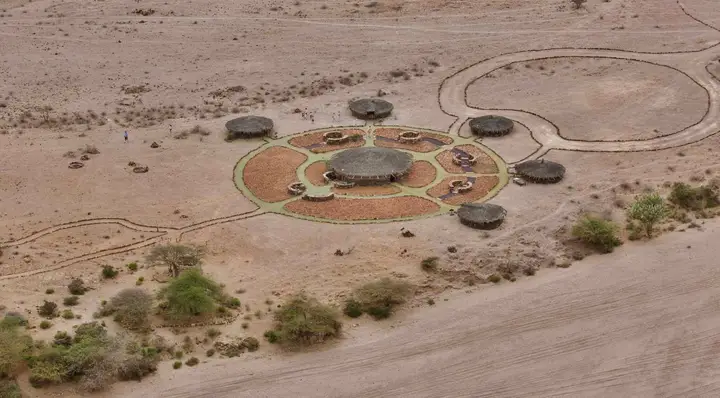
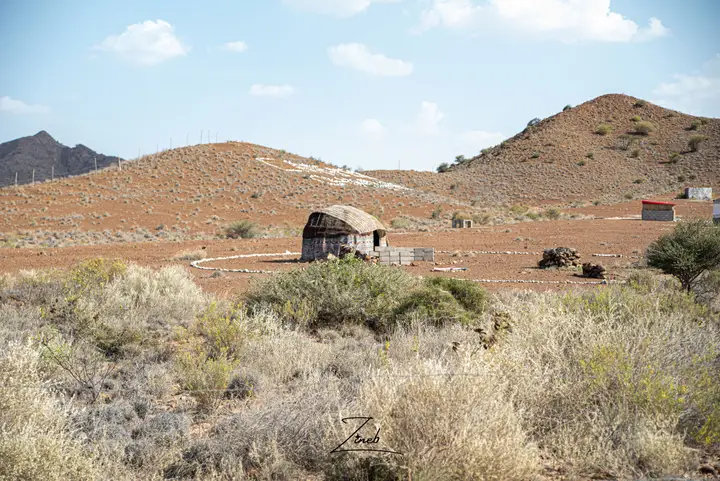
- Dhaydhan — near Ali-Sabieh, traditional toukouls, a night under mosquito nets and nomadic cooking.
- Rayali chez Fato — at the mouth of Rayali bay, paillotes, fish of the day and coral a few metres from the beach.
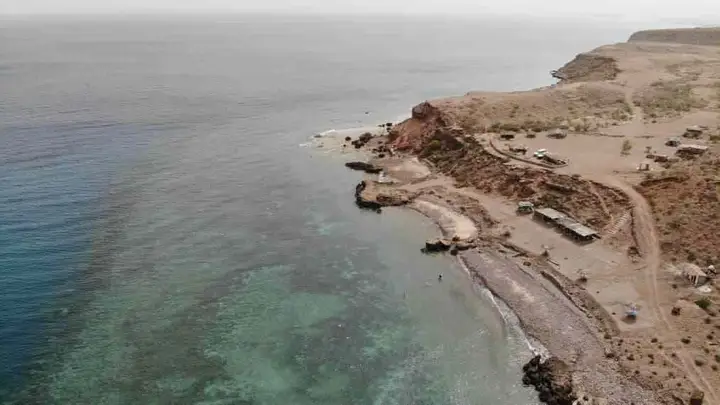
- Ras-Bir Houguef — twelve daboitas on a rocky platform above a small fine-sand beach.
- Khor Ambado — a night by the beach twenty kilometres from the capital, on a track reachable by 4×4.
As a sourced reference, count the bungalows on Douda beach at between 4,000 and 12,000 Djiboutian francs depending on their size and how close they are to the shore — site access being charged at around 500 Djiboutian francs per person.
How many nights, and when to book?
Three nights are enough for a first stay centred on the capital and its surroundings. Five nights allow a night in Tadjourah or Les Sables Blancs and a night in a camp in the Forêt du Day. Seven nights open up Lake Abbe and the north.
Book early over the November to January period: whale shark season coincides with the European holidays, and the capital’s hotel stock is limited. Camps on the north coast sometimes have fewer than ten rooms. February to April remains more flexible, and May and September are the easiest months to book.
Always check three points before confirming: that there is air conditioning, that breakfast is included and that an airport transfer is possible.
How to choose according to your profile?
- One or two nights, in transit → Haramous, ten minutes from the airport.
- A business stay → Plateau du Serpent, everything on foot.
- A holiday mixing city and sea → Le Héron, swimmable beach and quiet.
- A tight budget → old town and central market.
- A nature trip → camps in the Forêt du Day, at Djalélo or on the north coast.
- A seaside escape → Les Sables Blancs, Rayali or Village de la Mer Rouge.
To settle your dates before booking, see when to go to Djibouti. For temperatures and kit, weather and climate. For journeys between the capital and the north coast, car rental or the ferry to Tadjourah and Obock.
Where to stay
Filter by region
Affordable hotels in Djibouti: the 3★ against their rating
Assamo camp: sleeping in the land of the beira
Camps and ecolodges: sleeping in the wild
Dhaydhan camp: a nomadic night near Ali-Sabieh
Dittilou camp: sleeping in the cirque
Djalelo camp: the ecolodge of the protected valley
La Maison des Randonneurs: sleeping in Arta, pack on
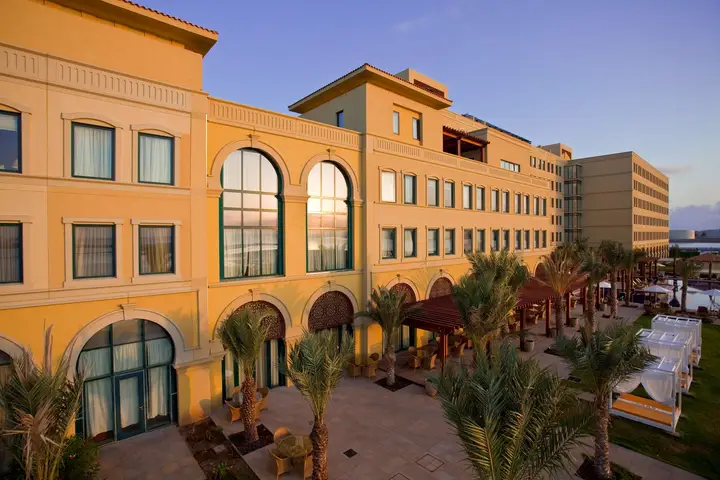
Luxury hotels in Djibouti: the 4★ and 5★ against their score
Ras-Bir Houguef: the isolated camp on the Obock coast
Rayali chez Fato: the camp of Rayali bay
Residences and apartments in Djibouti: the real offers
Seven Brothers camp: the Khor-Angar mangrove, at Obock
Village de la Mer Rouge: bungalows and beach at Obock
Where to sleep in Ali-Sabieh: town hotels and camps
Where to sleep in Arta: the Sinny Hill Center and the alternatives
Where to sleep in Dikhil and at Lake Abbe: hotels and bivouac
Where to sleep in Djibouti City, district by district
Where to sleep in Obock: camps and bungalows
Where to sleep in Tadjourah: Sables Blancs and Loubatanleh
Compare bookable accommodation in DjiboutiSecure booking, verified provider.
Frequently asked questions
Which is the best district to stay in Djibouti City?
The Plateau du Serpent holds most of the hotels, restaurants and services, and can be walked in the evening. Le Héron is more residential, quieter, and lies a few steps from the beach of the same name, the only truly swimmable city beach. If your priority is practical comfort and dinners nearby, choose the Plateau du Serpent.
Where to stay in Djibouti for an early morning departure?
Around Haramous, south of the capital, about seven kilometres from Ambouli international airport, or some ten minutes by road. This residential area has several establishments, including a hotel whose name claims proximity to the airport. It is also the logical starting point for Douda beach and the Haramous marine protected area.
Can you sleep in a camp in Djibouti?
Yes, and it is often the best part of the trip. The country has ecotourism camps in the Forêt du Day and the Dittilou cirque, at Djalélo, at Assamo, at Dhaydhan near Ali-Sabieh, and at Rayali and Ras-Bir Houguef on the coast. Comfort is simple, sometimes with no electricity or running water, but the welcome and the local cooking more than make up for it.
How much does a night cost in Djibouti?
Ranges vary widely by district and category. As a documented reference, the bungalows on Douda beach are advertised at between 4,000 and 12,000 Djiboutian francs depending on their size and how close they are to the shore. In the city, expect more, with a marked gap between the old town and the establishments on the Plateau du Serpent. Firm prices are shown on Dalmar.
Should you book accommodation in advance in Djibouti?
Yes, especially between November and January, when whale shark season coincides with the holidays and fills the capital. The hotel stock is limited and the camps on the north coast have few places. Book several weeks ahead over that period, and always check whether breakfast, air conditioning and the airport transfer are included.