Korili: the hot springs of the Lake Assal sector
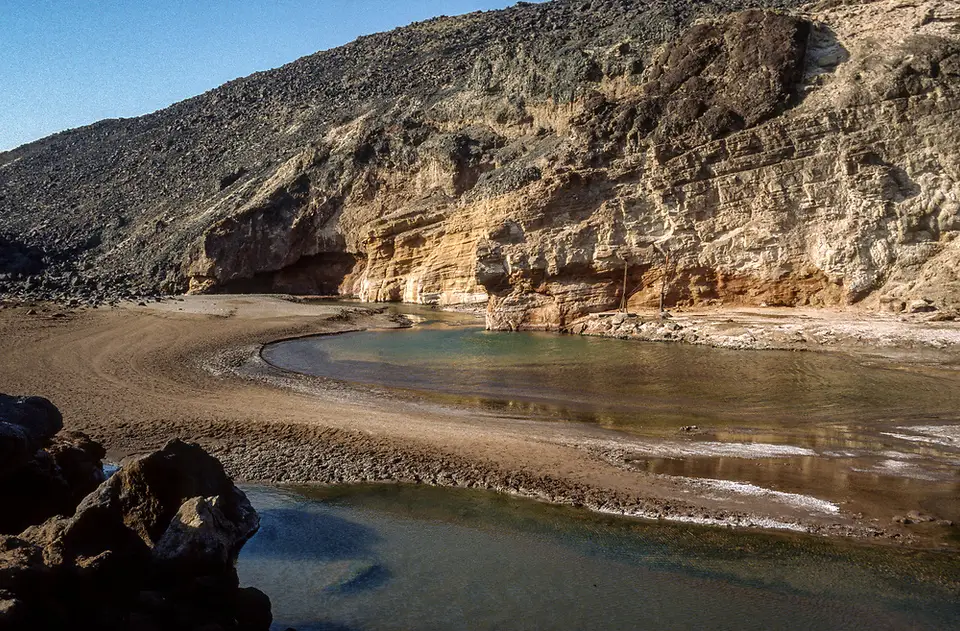
Korili is a group of hydrothermal springs in the Lake Assal sector, Tadjourah region. The water springs along a fracture and has built an alignment of travertine chimneys, formed in the presence of carbonatogenic bacteria at a time when the lake level was higher. You observe fumaroles, salt flowers and eggshell crystallisations there. The site is visited as part of a Lake Assal excursion.
We publish no temperature for Korili. The figures in circulation are attached to no published, consultable measurement. The readings we found in the geological literature concern the hot stream that flows out of the springs, and not the springs themselves. The page therefore describes what can be observed — very hot water, abundant steam, fumaroles — without giving any degrees.
Where are the Korili hot springs?
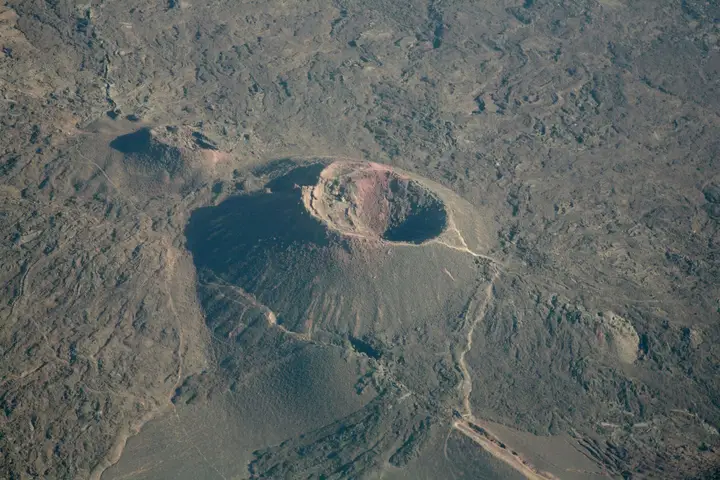
Korili lies in the Lake Assal sector, Tadjourah region. The Dalmar catalogue ties the site to Lake Assal and places its coordinates at 11.604 N and 42.414 E, near the Ardoukoba volcano and the salt pans.
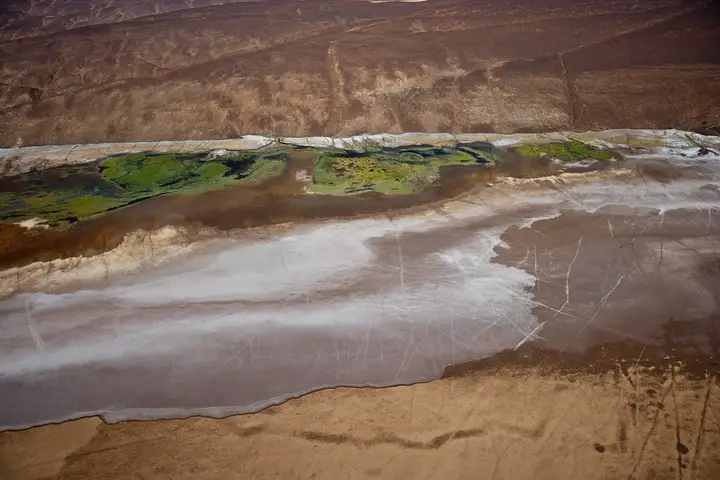
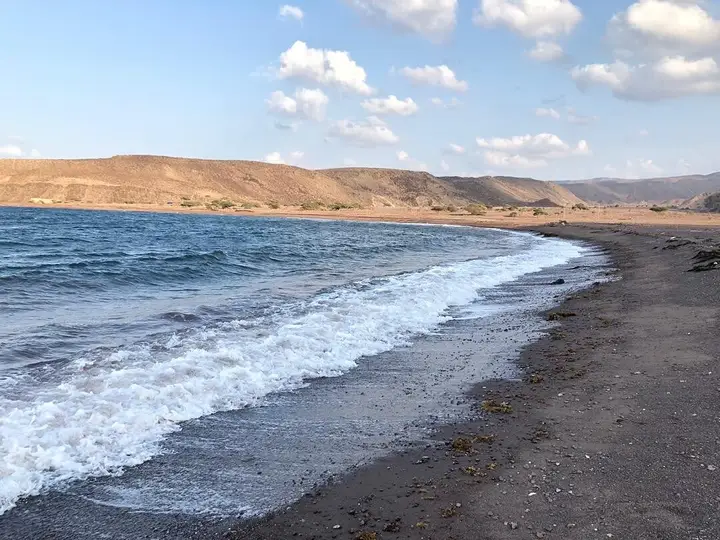
The setting is that of a rift floor: steep mountains, cliffs, basaltic flows and evaporite deposits. The springs emerge along a fracture that extends towards the south-east. It is that fracture which explains the geometry of the site: the water outflows are not scattered, they align.
What do you see at Korili?
The site reads as a succession of phenomena linked to the same hot water.
The travertine chimneys. They form an alignment along the fracture. These are structures built by the water itself, laden with calcium ions, and not volcanic rocks.
The fumaroles and steam. The steam emissions signal the springs from a distance and give the site its unsettling look. They are particularly visible in the cool hours.
The salt formations. Nearby, the water deposits carbonated salt flowers and, in the alluvium, eggshell crystallisations formed by capillary rise.
The hot stream. The water flows towards the lake and forms an environment the geological literature describes as sapropelic, with a bacterial and algal film and gas releases linked to photosynthetic activity.
| Reference | Data | Source |
|---|---|---|
| Region | Tadjourah | Dalmar catalogue |
| Sector | Lake Assal (catalogue address) | Dalmar catalogue |
| Coordinates | 11.604 N — 42.414 E | Dalmar catalogue |
| Nature of the site | Hydrothermal springs on a fracture | Dalmar catalogue and Berger |
| Formations | Travertine chimneys aligned towards the south-east | Berger |
| Mechanism | Water laden with calcium ions, carbonatogenic bacteria, a higher lake level | Berger |
| Salts | Carbonated salt flowers, eggshell crystallisation | Dalmar catalogue and Berger |
| Period of the crystallisations | Frequent between December and April | Berger |
| Facilities | None described in the catalogue | Dalmar catalogue |
Why does Korili interest geologists?
Three things can be read here.
First an ancient lake level. The travertine chimneys were built underwater, in the presence of carbonatogenic bacteria, at a time when Lake Assal was higher. The site is therefore a palaeo-level marker: it documents a geometry of the lake that no longer exists.
Then an extreme environment. The geological literature notes thermophilic bacteria at Korili, that is, organisms that develop in environments once believed closed to life.
Finally an archive of the fault. Above the springs, the fault carries limestone encrustations of hydrothermal origin, and the sector shows an unusual succession: a recent basaltic flow covers a diatomite limestone deposit more than two metres thick, itself laid on volcano-detrital deposits. In the background stands the eroded edifice of Gale le Kôma, made of hyaloclastites covered by a thin basaltic flow.
How do you visit Korili?
The catalogue describes neither ticketing nor a visitor structure. So bring your own water, sun protection and closed shoes, and treat the visit as a field stage, not an equipped attraction.
In practice, Korili is visited as part of a Lake Assal excursion: the site belongs to the same sector, and the stop is made on the route leading to the salt pans. The Lake Assal page details access to the sector and the fact that the last kilometres are on track; Goubet al-Kharab and Ardoukoba naturally complete the same day.
Two elementary precautions. Do not put your hands in the water of the vents, and keep children at a distance: nothing marks the water outflows. Do not walk on the travertine chimneys, which are fragile and irreplaceable.
When should you observe the salt flowers?
Eggshell crystallisation, in the alluvium near the springs, is described as frequent between December and April. That is also the most comfortable period for crossing the sector: the heat of the basin becomes hard to bear from spring onwards.
As everywhere around Lake Assal, set off early. The page when to go to Djibouti gives the month-by-month detail, and the Tadjourah page covers the rest of the regional hinterland.
Frequently asked questions
Where are the Korili hot springs?
In the Lake Assal sector, Tadjourah region. The Dalmar catalogue ties Korili to Lake Assal and places its coordinates at 11.604 N and 42.414 E. The site lies near the Ardoukoba volcano and the salt pans, in a landscape of volcanic mountains and cliffs. It is reached as part of an excursion to the lake, on a route that already crosses this sector.
What do you see at Korili?
An alignment of travertine chimneys built by the hot water, steam emissions and fumaroles, salt deposits in the form of carbonated salt flowers, and eggshell crystallisations in the alluvium. The hot stream flowing from the springs forms an environment where a bacterial and algal film develops, with gas releases linked to photosynthetic activity.
Why does Korili interest geologists?
Because the travertine chimneys tell the lake's history. Water laden with calcium ions built those chimneys in the presence of carbonatogenic bacteria, while they were underwater: the lake level was therefore higher than today. The site also allows you to observe thermophilic bacteria, which develop in environments considered extreme, and the limestone encrustations of the fault.
Can you bathe in the Korili springs?
Nothing in the sources consulted describes a built pool, and the water flowing from the springs is very hot. Bathing is therefore not the purpose of the visit: you come to observe a geological phenomenon. The sector also imposes its own precautions, between heat, salt and the absence of shade. Stay away from the vents and do not put your hand in the water.
When do you observe the salt flowers at Korili?
Crystallisation of salt into eggshell form, in the alluvium near the springs, is described as frequent between December and April. That period corresponds to the cool season, the most comfortable for crossing the Lake Assal sector. Set off early in the morning: the basin concentrates heat and natural shade is scarce there.
Sources
Location
Lat. 11.60410Lng. 42.41351
Destinations
Read next
Abourma: the rock engravings of the Makarrassou massif
Ali-Sabieh: the south-east region, sites and camps
Allols depression: salt, hot springs and caravans
Ardoukoba: the most recent volcano in Djibouti
Arta: the cool of the interior and whale sharks
Assamo: the protected area of the beira antelope
Balho: rock art and the northern border post
Bankoualé: the oasis at the foot of the Goda massif