Djibouti in 7 days: the rift, the desert and the north coast
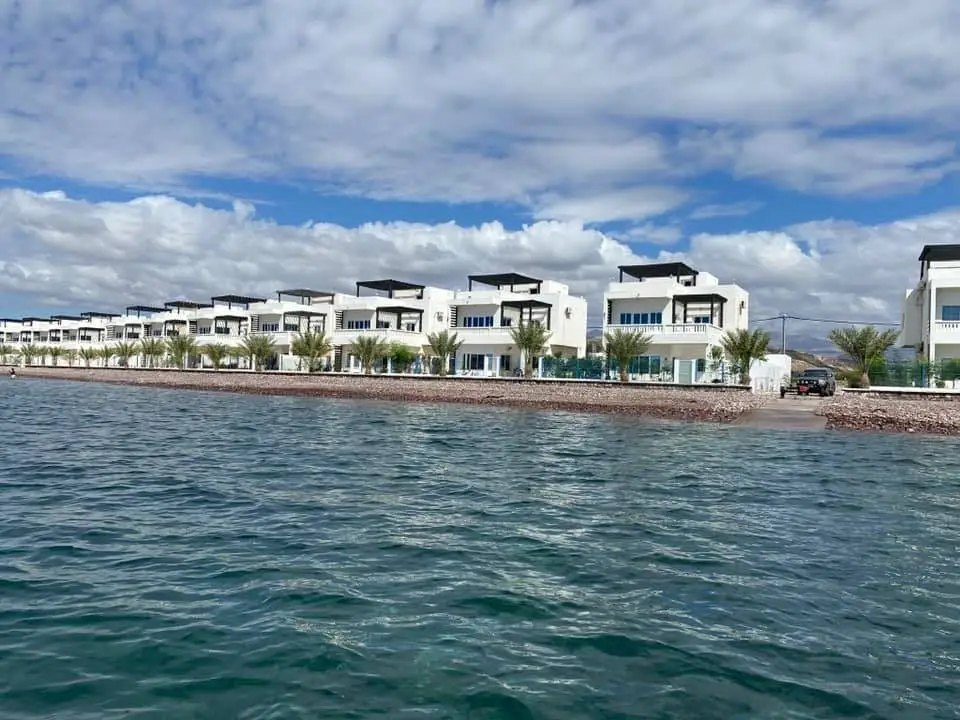
A 7-day and 6-night stay in Djibouti reads in three blocks: the coastal base, with the city, Lake Assal and a sea outing, then the southern desert, with a night at Lake Abbe, finally the north coast and the Forêt du Day. This programme is an organisational recommendation, never a package sold as such. The services it uses are published separately, from 8,000 to 120,000 Djiboutian francs.
What this page is, and what it is not. Seven days is the last duration for which we have a documented demand. What follows is an organisational recommendation: it combines verified sites and services published separately. It is not the programme of a sold offer, and no amount quoted here is our rate.
Seven days in Djibouti: what is the logic of the programme?
It is the duration from which the country stops being a succession of excursions. At two or three days, you have to choose between the rift and the sea. At seven, you can do both, add the southern desert and sleep twice outside the capital without sacrificing the rest.
The programme rests on three blocks, and on a single rule: each block heads in one direction and does not come back.
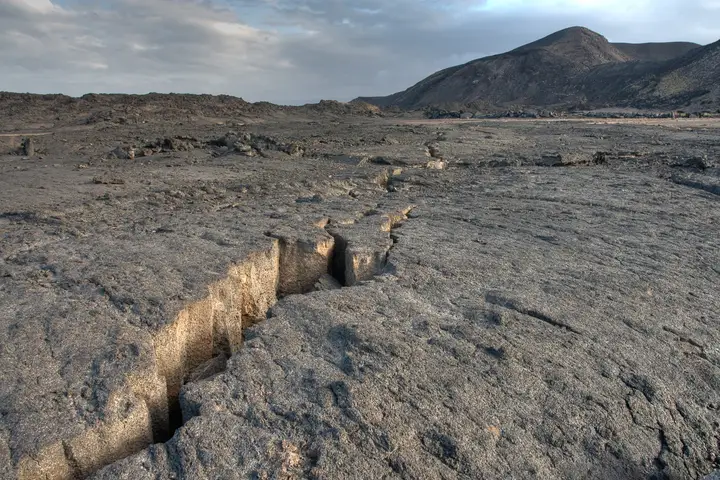
- The coastal base — three days. The city, the Afar rift along the Lake Assal road, then a day at sea in the Gulf of Tadjourah. Three nights in Djibouti City, with no change of accommodation.
- The southern desert — two days. The Dikhil road, Lake Abbe and its night on site, then the return. This block does not compress: the site is too far for a there-and-back within the day, and the published formulas themselves stretch over two or three days.
- The north coast and the mountains — two days. The ferry to Tadjourah, a night at Les Sables Blancs beneath the black-rock cliff, then the Forêt du Day or the Dittilou cirque before returning to town.
The catalogue publishes two tours that cover part of those blocks. A complete four-day tour, sold at 120,000 Djiboutian francs per person and titled “Le Meilleur de Djibouti”. And a three-day tour, sold at 85,000 Djiboutian francs per person, whose title announces Lake Abbe, Lake Assal, Tadjourah and Sable Blanc. We cite them because their price is published — not because their day-by-day unfolding would be known: their exact content is checked in the quotation, and the programme below is ours, not theirs.
What is the programme, day by day?
| Day | Axis | Stages | Overnight |
|---|---|---|---|
| 1 | City | Arrival at Ambouli, limbering up in Djibouti City: place du 27-Juin, market, seafront | Hotel in Djibouti City |
| 2 | Rift, heading west | Arta (42 km) then Lake Assal (about 120 km) and the Goubbet al-Kharab viewpoint | Hotel in Djibouti City |
| 3 | Sea, Gulf of Tadjourah | Boat outing: Moucha and Maskali islands, or whale sharks from 15 October to 15 March | Hotel in Djibouti City |
| 4 | South-west track | Dikhil road, approach to Lake Abbe, setting up the bivouac | Bivouac at Lake Abbe |
| 5 | Lake Abbe then return | Limestone chimneys at dawn, walk on the former lake bed, return towards the capital | Hotel in Djibouti City |
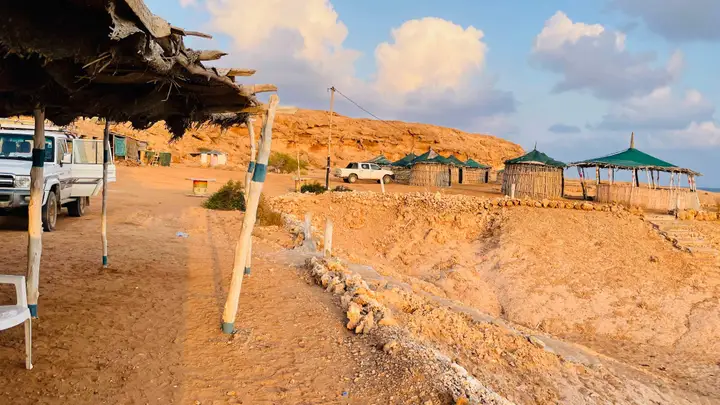
| 6 | North coast | Ferry to Tadjourah, then night at Les Sables Blancs | Beach camp |
| 7 | Mountains and departure | Forêt du Day or Dittilou cirque, return to town, airport transfer | — |
Two methodological clarifications, because they decide whether this is feasible.
The kilometres given are those published on our pages — 42 kilometres for Arta, about 120 for Lake Assal. We publish no estimate for the stretches whose distance is not sourced, and notably not for the Lake Abbe track, of which none of our sources gives the mileage.
Day 6 depends on a timetable, not on a choice. The ferry to Tadjourah leaves only on certain days of the week, and to Obock on other days again: the north coast day has to be set to the company’s schedule, not the other way round. Departure days, fares and seasonal interruptions are on the page ferry Tadjourah and Obock.
What you do, day by day
Day 1 — Djibouti City. An arrival at Ambouli is about seven kilometres from the centre. The first day is for finding the rhythm: place du 27-Juin and its colonial-architecture buildings, the market, the seafront. Nothing athletic: it is the day you recover from the flight, and a visit of the town counts as one day on foot, possibly extended by half a day.
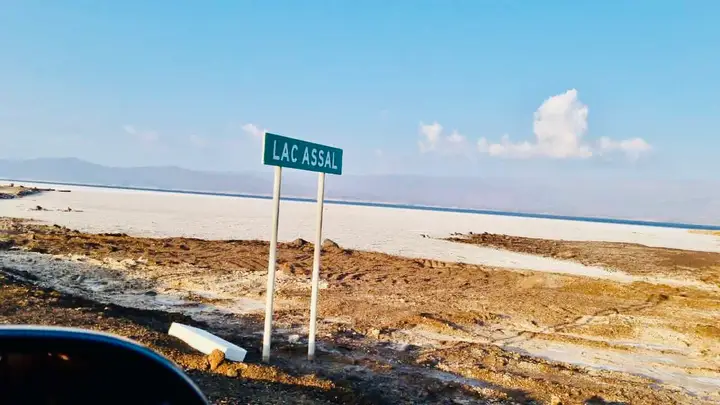
Day 2 — The rift and the salt. Departure at dawn to the west by the Ethiopia road. Arta marks the break: 42 kilometres from the capital, the altitude brings coolness. Then the descent to the Lake Assal basin, 155 metres below sea level, with the swim where you float without effort and the walk on the salt crust. On the way back, the Goubbet al-Kharab viewpoint overlooks an inlet hemmed in between cliffs. There is no resupply on those sites: the picnic is brought along.
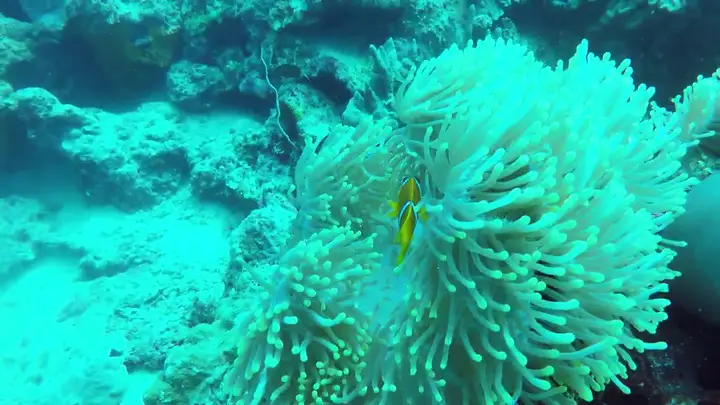
Day 3 — The sea. Three options according to the season and the profile. The Moucha and Maskali islands, about 45 minutes by boat, for easy snorkelling. The Arta Plage and Ras Korali sector, for whale shark watching. Or the gulf’s dive sites, for certified divers. The whale shark outing falls within a regulatory window: from 15 October to 15 March under decree no. 2023-362/PR/MCT, with a peak of presence from November to January.
Days 4 and 5 — Lake Abbe. This is the most demanding block of the stay. The track crosses the Gobaad depression, in the Dikhil region, to a cross-border salt lake whose crystallised limestone chimneys reach 30 to 50 metres. The site is a protected terrestrial area: you move around with a guide, you take nothing, you take all your waste back. The night on site is not an extra flourish: it is what allows you to be on the site at dawn, when the low light separates the columns from the ground.
Day 6 — The north coast. Crossing the gulf by ferry — about an hour and thirty minutes, against forty-five minutes by fast boat — or going round by road, about 180 kilometres. Tadjourah first, then Les Sables Blancs for the night in a camp.
Day 7 — The mountains, then departure. The Forêt du Day occupies the Goda massif: 30 square kilometres of forest cover, a high point at 1,782 metres and the summit of the massif at 1,799 metres at Bara’barré. You walk there, you do not climb. The return to town follows, with a margin to keep before the flight.
What does not fit into seven days?
This is the useful part of a programme: what it excludes. Seven days are enough for three blocks, not for six.
| Left out of this programme | What it would take to add it |
|---|---|
| Obock and the Godoria mangroves, about 240 kilometres by road | A night on site, and at least one more day: Obock is treated as a northern block, not as a stage |
| The Seven Brothers archipelago, to the north | A dedicated boat outing, reserved for divers, and therefore a whole day sacrificed to the rest |
| Assamo and its protected area, about 120 kilometres | A night in an ecotourism camp, far from any road |
| The Grand Bara and the Holl-Holl viaduct | A day of track and a suitable vehicle, to be combined with the south |
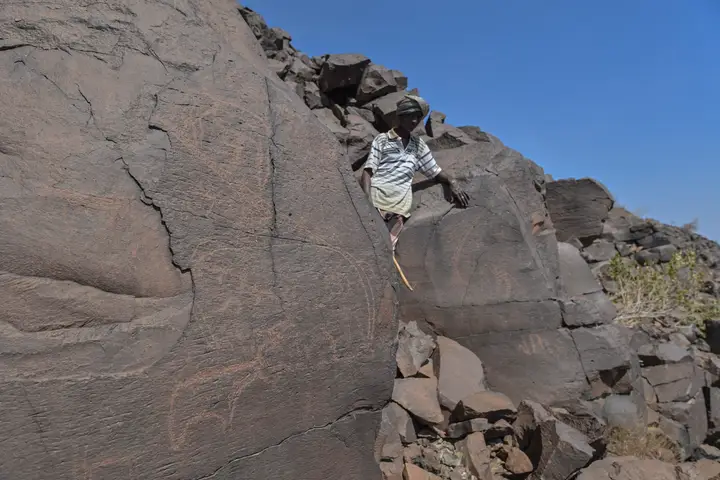
| The Abourma engravings, in the Tadjourah region | A track and a walk: it is a guided site, never an improvised stop |
| The Allols depression | A detour via the north-west coast, incompatible with the gulf crossing |
| Diving on wrecks and drop-offs in the gulf | A themed stay: two or three outings are worth more than a single one |
Three of those sites — Obock, Assamo, Abourma — each justify a day on their own. Stacking them into the same week produces exactly what an itinerary must avoid: four sites glimpsed from a 4×4 instead of two lived. That is what distinguishes a week in Djibouti from a road marathon.
How much does a seven-day stay cost?
No published package exists for seven days. Every item this programme uses, however, is sold separately at a published price. The table below gathers them: it is a reconstruction, not a rate.
| Item of the programme | Published offer | Price |
|---|---|---|
| Coastal block as separate excursions | One-day Lake Assal excursion + outing to the Moucha and Maskali islands | 18,000 + 8,000 Fdj per person |
| Marine wildlife variant on day 3 | Whale shark encounter departing from Arta Plage | 25,000 Fdj per person |
| Desert block, two days | Two-day tour: Lake Abbe and Lake Assal | 55,000 Fdj per person |
| Desert variant in three days | Lake Abbe, Tadjourah and Lake Assal in 3 days | 44,500 Fdj per person |
| Desert and north coast block, three days | 3-day tour: Lake Abbe, Lake Assal, Tadjourah and Sable Blanc | 85,000 Fdj per person |
| Coastal base and north coast, four days | Complete 4-day tour: Le Meilleur de Djibouti | 120,000 Fdj per person |
| Night at Lake Abbe | Lake Abbeh package, with bivouac | 53,000 to 133,500 Fdj per person according to group size |
| Day in the Forêt du Day | Forêt du Day package, with transport | 35,600 to 87,220 Fdj per person according to group size |
| Night in a camp, north coast | Camping on full board at Les Sables Blancs | 10,000 to 15,000 Fdj per person |
| Day of vehicle on track | 4×4 with driver | about 44,000 Fdj per vehicle per day |
| Crossing to Tadjourah | Ferry Djibouti City ↔ Tadjourah | 700 Fdj per adult, one way |
| Accommodation, base of the stay | Room in a Djibouti City hotel | 7,800 to 91,492 Fdj per night |
Two warnings about that table.
The 4×4 rate is neither a catalogue price nor an official rate. The offer type “vehicle hire” does not exist in the partner platform’s catalogue, and the national tourism agency publishes no hire grid. The 44,000 francs come from a commercial display and must be confirmed by a written quotation; our page on 4×4 hire with a driver details that point.
The items add up, they do not substitute for one another. Taking the complete four-day tour and the Lake Assal excursion amounts to paying twice for the same journey. A seven-day programme is costed by choosing one column, not by ticking every line.
Two price gaps we do not smooth over
The catalogue contains two anomalies we cannot explain, and which we publish as they stand.
- Three days cheaper than two. The tour “Lake Abbe, Tadjourah and Lake Assal in 3 days” is 44,500 Djiboutian francs, when the 2-day tour “Lake Abbe and Lake Assal” is 55,000 francs — for a shorter programme.
- Same announced content, double the price. The tour “Djibouti city and Lake Assal in 2 days” is 15,130 Djiboutian francs, when the tour “Ville de Djibouti et lac Assal” in 2 days shows 35,000 francs.
Either the basis of calculation differs from one operator to another, or one of the two prices is wrong. We will not decide in your place: ask for a written quotation, having what is included specified — transport, guide, meals, night, site permits. It is the only way to compare two lines that announce themselves as identical and may not be.
How does the season change the programme?
| Period | What works | What has to be moved |
|---|---|---|
| November – February | The whole programme, including Lake Abbe and the Forêt du Day | Nothing: it is the window to aim for |
| March – April | The coastal base and the north coast | Lake Abbe remains acceptable, but the heat rises |
| May | The sea, the islands, Tadjourah | Lake Abbe becomes inadvisable |
| June – August | The days at sea and the mountains | The inland basins: very early departure, or postponement |
| September | The coast and the islands | Lake Abbe remains difficult |
| October | The whole programme | Nothing, apart from the reopening of the whale shark window |
Three calendar points genuinely govern the organisation.
The whale shark window runs from 15 October to 15 March under decree no. 2023-362/PR/MCT. Outside that window, no operator is authorised in the observation zone: day 3 then shifts to the islands or to diving. The peak of actual presence falls from November to January.
Lake Abbe has its own season. The Gobaad depression counts among the hottest areas in the country: from November to February the track holds and the nights are bearable, from June to August the bivouac becomes suffocating.
The ferry has interruptions. It stays about an hour at the quay, it is more or less stopped from mid-July to the end of August, and totally stopped on public holidays. A summer stay resting on the gulf crossing must therefore plan the road detour, about 180 kilometres.
Which traps should you avoid over a week?
- Do not plan Lake Abbe as a there-and-back within the day. No published formula proposes it, and for a reason: the track is long and without organised supplies.
- Do not put the boat outing on the day of the return flight. The sea can delay the return, and the safety margin becomes zero.
- Do not fix the north coast without checking the ferry days. The grid does not cover the whole week, and missing a crossing costs a day.
- Do not forget that the 4×4 is booked in advance. The fleet of vehicles with drivers is limited and fills up in the same weeks as the hotels, especially from November to January.
- Do not confuse a commercial display with a catalogue price. The 4×4 rate is a display: demand a written quotation mentioning fuel, mileage, access permits and insurance.
- Do not count on bank cards outside the city. Plan for cash for the camps, the markets, site entries and tips.
- Do not set off late in the morning on the inland days. From midday, the Lake Assal basin becomes an oven and the salt throws the heat back.
- Do not add up the tours. Two services covering the same journey are paid for twice; it is the most frequent budgeting error over a week.
What if you have more than seven days?
Beyond seven days, our research corpus documents no further demand: we know of no query covering ten days or two weeks in Djibouti. We therefore do not build those durations as day-by-day programmes, but as explicit assemblies of this programme and of shorter itineraries already published.
Two pages deal with what follows, and each says what it combines: Djibouti in 10 days and Djibouti in 2 weeks. The short base remains Djibouti in 2 days. If your plan includes Ethiopia, the railway line to Addis Ababa is prepared separately and read in Djibouti and Ethiopia.
Frequently asked questions
What can you see in Djibouti in a week?
Three sets, and they are enough to fill seven days without rushing. The coastal base first: Djibouti City, Arta, Lake Assal 155 metres below sea level, and a boat outing in the gulf, to the Moucha and Maskali islands or to the whale sharks in season. The southern desert next, with a night at Lake Abbe. The north coast finally, with Tadjourah, Les Sables Blancs and the Forêt du Day.
How much does a seven-day stay in Djibouti cost?
No seven-day package is published, but the items are. A one-day excursion to Lake Assal sells for 18,000 Djiboutian francs per person, an outing to the Moucha and Maskali islands 8,000, a whale shark encounter 25,000, a three-day tour from 44,500 to 85,000, and the catalogue's complete four-day tour 120,000. Nights run from 7,800 to 91,492 francs.
Do you really need to sleep at Lake Abbe during a week in Djibouti?
Yes, if you want to see the site in good conditions. The track is long and partly sandy, and it crosses an arid environment with no organised supplies. The published formulas stretch over two or three days, with a night on site or nearby. It is also what allows you to arrive for the evening light and leave in the morning light.
Can you follow this programme without a 4×4 and a driver?
Only in part. Arta, Lake Assal, Tadjourah and Obock are reached by tarmac road. Lake Abbe, the Goubbet al-Kharab, the Forêt du Day and the Dittilou cirque, on the other hand, require the track, and therefore a 4×4 with a driver. The displayed rate sits around 44,000 Djiboutian francs per day per vehicle, a commercial amount to be confirmed by written quotation.
What is the best period for a seven-day stay?
From October to April. Temperatures come down, the inland basins become workable again and the sea is calmer for boat outings. For Lake Abbe, aim for November to February: the Gobaad depression counts among the hottest areas in the country. The regulatory whale shark window runs from 15 October to 15 March.
Sources
Itineraries
Read next
Budget in Djibouti: backpacker, mid-range, luxury
Culture and heritage: rock art and old cities in four days
Desert and lakes: salt, rift and Lake Abbe in four days
Diving in Djibouti: the three-day itinerary
Djibouti and Ethiopia: combining the two countries
Djibouti in 1 day: the rift or the beach?
Djibouti in 10 days: the assembly of three itineraries
Djibouti in 2 days: the rift, the salt and the sea