Djibouti City: the capital, district by district
Djibouti City is the capital of the Republic of Djibouti and the starting point for almost every circuit in the country. The town can be visited on foot in a day: place du 27-Juin and its colonial district, place Mahamoud-Harbi and its market, the Al-Hamoudi mosque of 1906, the Ambouli gardens, then Heron and Siesta beaches. Allow an extra half-day for the Eega memorial and the large recent mosques.
Where is Djibouti City?
Djibouti City occupies a peninsula at the mouth of the Gulf of Tadjourah, on the African shore of the Bab el-Mandeb strait. It is at once the political capital, the country’s first port and the starting point for almost every circuit inland: Lake Assal, Lake Abbe, Tadjourah, Obock, Arta.
The town reads in two movements. The historic centre concentrates the colonial architecture, the markets and the places of memory; it is walked, preferably early in the morning. Around it, a crown of more recent districts — Balbala to the south-west, the southern districts and the airport axis — holds the large contemporary mosques, the gardens and the hotels.
Key facts
| Reference | Data |
|---|---|
| Status | Capital of the Republic of Djibouti |
| Administrative region | Djibouti |
| Centre coordinates | 11.593 N — 43.146 E |
| Historic districts | 27-Juin, Mahamoud-Harbi, Rue des Mouches |
| Outer districts | Balbala, Cheick Osman, Ambouli |
| Recommended way to visit | On foot in the morning, by taxi after |
| Recommended duration | 1 to 2 days |
| Best season | November to March |
| Entry points | Djibouti-Ambouli international airport, Nagad station |
What is there to see in Djibouti City?
The colonial district and place du 27-Juin
Formerly place Ménélik, place du 27-Juin is the heart of the old colonial district. Most of the buildings around it have kept their original architecture, with Moorish arcades under which you settle at a terrace to watch the town.
Around the square radiates a grid of streets bearing the names of foreign capitals, lined with shops, restaurants and cafés. The tourist office is there, along with the white and green taxis. In the evening, the area concentrates the capital’s nightlife.
Place Mahamoud-Harbi and its market
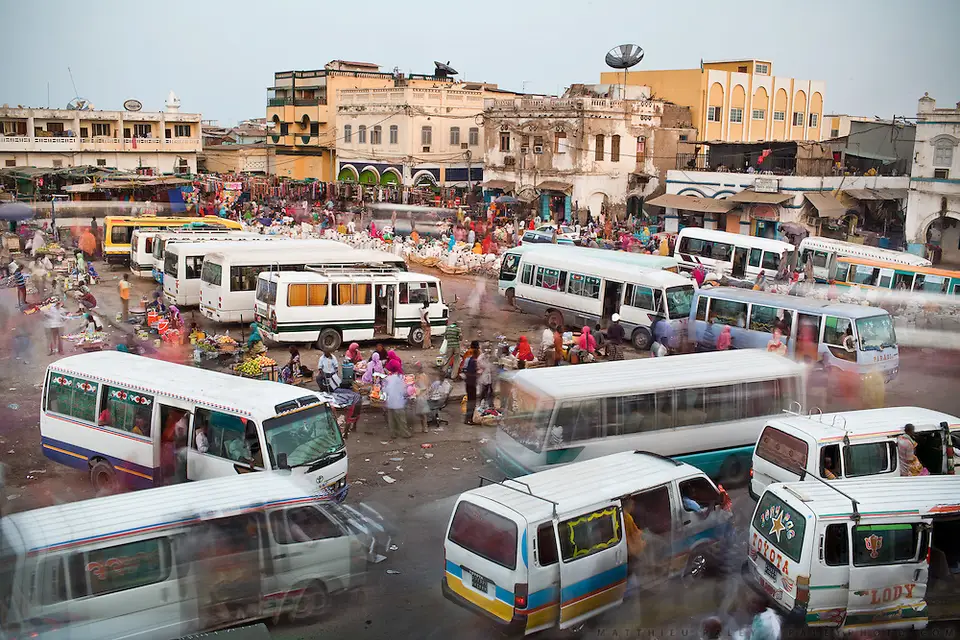
Once place Rimbaud, place Mahamoud-Harbi bears the name of a Djiboutian statesman who played a central role in the march to independence. Today it is a crossroads: open-air market, bus station, Moorish mosque, shops.
The spectacle is in the street. Spices, medicinal plants, clothes and crafts are sold there; donkey carts cross 4×4s, and radios broadcast the same music in three languages. Two detours are essential: the Al-Hamoudi mosque, a few steps away, and the Rue des Mouches, one of the largest markets in the town.
The Al-Hamoudi mosque, the oldest in the town
Built in 1906 by Hadji Hamoudi, the Al-Hamoudi mosque is one of the oldest religious buildings in the country. It follows the Abbasid style and can hold about 1,000 worshippers. Its central position makes it a hinge between the fruit and vegetable market, the fish hall, the butchers and the minibus station.
The place is still active: cover your head, remove your shoes before entering and avoid prayer times for a quiet visit.
The large contemporary mosques
Djibouti City has about 150 mosques. Three of them are worth the journey for their architecture:
- The Sultan Abdel-Hamid II mosque, opened in 2019, is the largest: more than 10,000 m², capacity for about 6,000 people, two minarets of 46 metres above a dome of 27 metres. The style is Ottoman, with calligraphy, an ablution fountain, a central chandelier and floors covered in wool felt — a solution suited to the climate.
- The Oumou-Salama mosque, opened in 2018 at PK13 in the commune of Balbala, covers 10,000 m² and stands out for its decorative mosaic and its access adapted for people with reduced mobility.
- The Doha mosque, near the second arrondissement, covers more than 4,500 m² and holds about 2,000 worshippers. It is often presented as the third largest in the capital, after Abdel Hamid II and Oumou-Salama.
The cathedral and the churches
On boulevard de la République stands Notre-Dame-du-Bon-Pasteur cathedral, seat of the diocese of Djibouti. It was built by Joseph Müller, an architect from Colmar, to replace the former Sainte-Jeanne-d’Arc church which had become too small, and consecrated on 12 January 1964. The diocese, created in 1955, gathers a small community.
A few streets away, the Ethiopian Orthodox Tewahedo Saint-Gabriel church, built in 1987, is recognisable by its silver dome.
The Eega memorial
At Cheick Osman, on national road 1 and facing the military camp, the Eega memorial occupies a heavy site. It recalls the 14.5-kilometre electrified barrier that divided the capital from 1967 until independence in 1977, erected to contain independence movements.
The site includes a reception room with a reconstructed checkpoint, a commemorative plaque, an archive library, an exhibition space, a projection room and a rest area. It opens Monday to Friday from 9 am to 5.30 pm and Saturday from 9 am to 12 noon. Entry is 200 Fdj for school pupils and students, 500 Fdj for adults and 1,000 Fdj for foreign visitors; groups are asked to give notice in advance.
The Ambouli gardens
In the southern districts, the Ambouli gardens form an oasis about one kilometre long and 400 metres wide, irrigated by a network of underground channels that capture the wadi’s water at depth. Doum palms, bougainvillea, hibiscus and pomegranate trees compose a landscape that contrasts sharply with the rest of the town. Come in the morning: the light is finer and the heat more bearable.
The town beaches
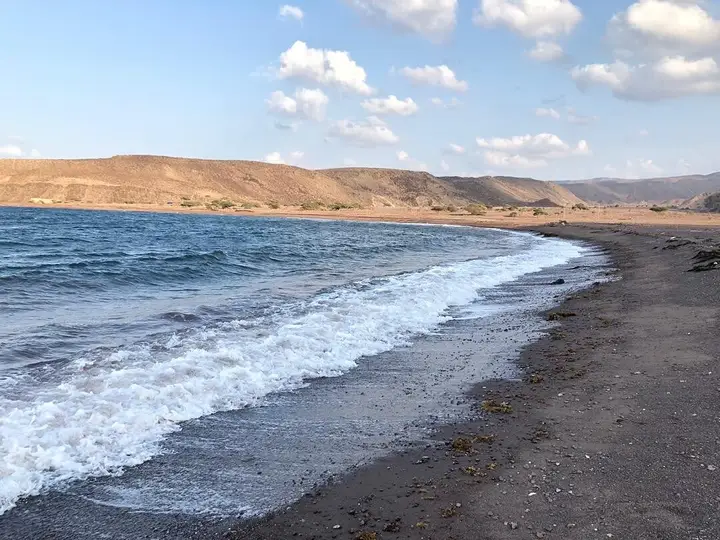
- Heron beach. A few steps from the centre, which is rare. It offers an open view over the ocean, a fine sunset, swimming, kitesurfing and beach volleyball. Restaurants nearby. The best slots are early morning and late afternoon.
- Siesta beach. The most popular in the town, very busy at weekends and during hot spells. The sea breeze is pleasant and kitesurfing is practised there. Swimming is not recommended, because of cleanliness problems linked to nearby sewers: come for the atmosphere, not to swim.
How do you get around the town?
| Mode | Typical use | Remark |
|---|---|---|
| On foot | Historic centre, markets, place du 27-Juin | In the morning, before the heat |
| Taxi | Between districts, airport | White and green taxis, price to be agreed |
| Minibus | Balbala, outskirts | Departing from place Mahamoud-Harbi |
| Car with driver | Trips outside the town | The most common formula for circuits |
| Train | Link to Ethiopia | Nagad station, south of the town |
The centre is very well visited on foot, but distances soon become long once you leave the colonial core. For the day, the most comfortable formula remains a car with a driver, which lets you combine centre, outskirts and beach without negotiating every trip.
When to go to Djibouti City?
| Period | Feel in town | Visitor numbers | Recommendation |
|---|---|---|---|
| November – February | The most bearable | High | Ideal window |
| March – April | Rising | Moderate | Visits early in the morning |
| May – September | Very gruelling | Low | To be avoided, unless a seaside stay |
| October – December | Falling | High | Good window |
The town being coastal, it benefits from a sea breeze that softens the hot hours without removing them. In summer, organise your movements before 9 am and after 5 pm, and keep outdoor site visits for the first hours.
How much does a stay in Djibouti City cost?
| Item | Indicative price | Detail |
|---|---|---|
| Swimming lesson, Heron beach | 3,000 Fdj | Supervised session |
| Seabed discovery (Raysali reef) | 6,000 Fdj | Exploration trip |
| Two-day city and Lake Assal tour | 15,130 Fdj | Economy formula |
| Two-day city and Lake Assal tour | 35,000 Fdj | Formula with a dedicated guide |
| Double room in a city-centre hotel | from 18,512 Fdj | Night, depending on the establishment |
| Room on the airport axis | from 21,360 Fdj | Night, handy for an early departure |
Price differences mostly reflect the comfort level of the accommodation and how supervised the trips are. For a two-day urban stay, the budget therefore divides mainly between the night and transport with a driver.
Where to stay in Djibouti City?
Three families of establishment stand out from the catalogue:
- City centre, around the colonial district: handy for visiting on foot, with double rooms from about 18,500 Fdj a night and suites around 34,700 Fdj.
- Airport axis: rooms and suites from about 21,400 Fdj, with the advantage of quick access to Djibouti-Ambouli international airport and Nagad station for an early departure.
- Upmarket hotels offering apartments and superior rooms with a sea view, up to about 91,500 Fdj for a suite: relevant for a long stay or a business trip.
Book early if you are travelling in the cool season or during a busy period: the capital’s hotel capacity remains limited relative to demand.
What should you know before setting off?
- Dress and customs. In active mosques, cover your head and remove your shoes. Avoid shorts and beachwear outside the beaches.
- Photography. Ask before photographing people, and refrain in front of military, port and official installations.
- Water. Do not drink tap water; bottled water is widely available in the shops of the centre.
- Heat. Regular hydration, hat, long sleeves. The town stays hot for much of the year.
- Money. Many shops and providers work in cash. Bring Djiboutian francs.
- Formalities. The electronic visa is requested before departure; check current conditions on the official portal.
How do you visit the town respectfully?
Djibouti City is not a film set: it is a dense town, where Somali, Afar, Arab, Ethiopian and European communities cross, in a majority Muslim country. A few principles are enough:
- Ask before photographing faces, homes or shops.
- Haggle with a smile, without humiliating: bargaining is part of the conversation, not a confrontation.
- Do not photograph children without an adult’s consent.
- Respect prayer times when visiting mosques.
- Put your waste in the bins: the urban shoreline badly lacks them.
The town is a stage, not a transit. Taking half a day to understand its colonial history, its port geography and the diversity of its districts changes the reading of the rest of the trip entirely: the country’s natural sites then take on their political and human dimension.
Preparing your trip
Check entry conditions on the official visa portal, then set your stay: the town combines naturally with Lake Assal over two days, or with the Moucha and Maskali islands over one day. Confirm the airport and Nagad station timings with your accommodation if you are continuing to Addis Ababa.
Frequently asked questions
What can you see in Djibouti City in one day?
Start with place du 27-Juin, formerly place Ménélik, at the heart of the colonial district and its Moorish arcades. Then move on to place Mahamoud-Harbi, its open-air market and the Al-Hamoudi mosque, built in 1906. Finish with the Ambouli gardens, finer in the morning, then Heron beach at sunset. The town is easily covered on foot.
Can you swim at Siesta beach?
Swimming there is not recommended. Siesta is the busiest beach in the town, appreciated for its sea breeze and its liveliness, but water quality is a problem because of nearby sewers. You can however enjoy the atmosphere, the neighbouring restaurants and kitesurfing. To swim, prefer Heron beach or the islands.
What does the Eega memorial in Djibouti commemorate?
The Eega memorial recalls the electrified barrier that divided the town during the colonial period. A 14.5-kilometre electrified barbed wire held the capital captive from 1967 until independence in 1977. The site, at Cheick Osman along national road 1, holds an exhibition room, a library and a projection space. It opens Monday to Friday and Saturday morning.
How much time should you allow for Djibouti City?
A full day is enough for the historic centre, the market and the Ambouli gardens. Add half a day if you want to visit the Eega memorial, Notre-Dame-du-Bon-Pasteur cathedral and the large recent mosques, which lie on the outskirts or in Balbala. Most circuits sold combine the town with Lake Assal over two days, which avoids an extra return trip.
Sources
Location
Lat. 11.59284Lng. 43.14590
Destinations
Read next
Abourma: the rock engravings of the Makarrassou massif
Ali-Sabieh: the south-east region, sites and camps
Allols depression: salt, hot springs and caravans
Ardoukoba: the most recent volcano in Djibouti
Arta: the cool of the interior and whale sharks
Assamo: the protected area of the beira antelope
Balho: rock art and the northern border post
Bankoualé: the oasis at the foot of the Goda massif